Le magazine et marché mondial pour les passionnés de voitures classiques, par des passionnés.
Le magazine et marché mondial pour les passionnés de voitures classiques, par des passionnés.


Filter
Faites votre choix:
- Voir les voitures
-
Marque >>
-
Année >>
-
-
Catégorie >>
- Voir les motos
-
Année >>
-
- Voir les pièces et plus
-
Marque de la voiture >>
-
Constructeur >>
-
Catégorie >>
-
Pays



10 Things You Should Know about the Amphicar

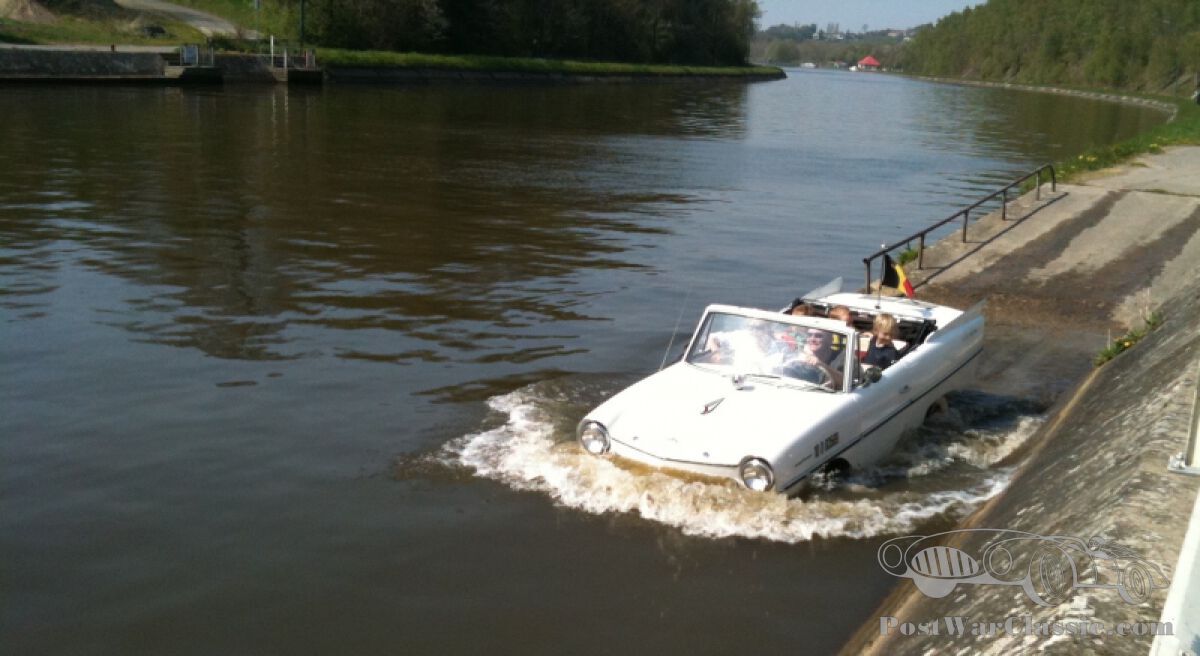

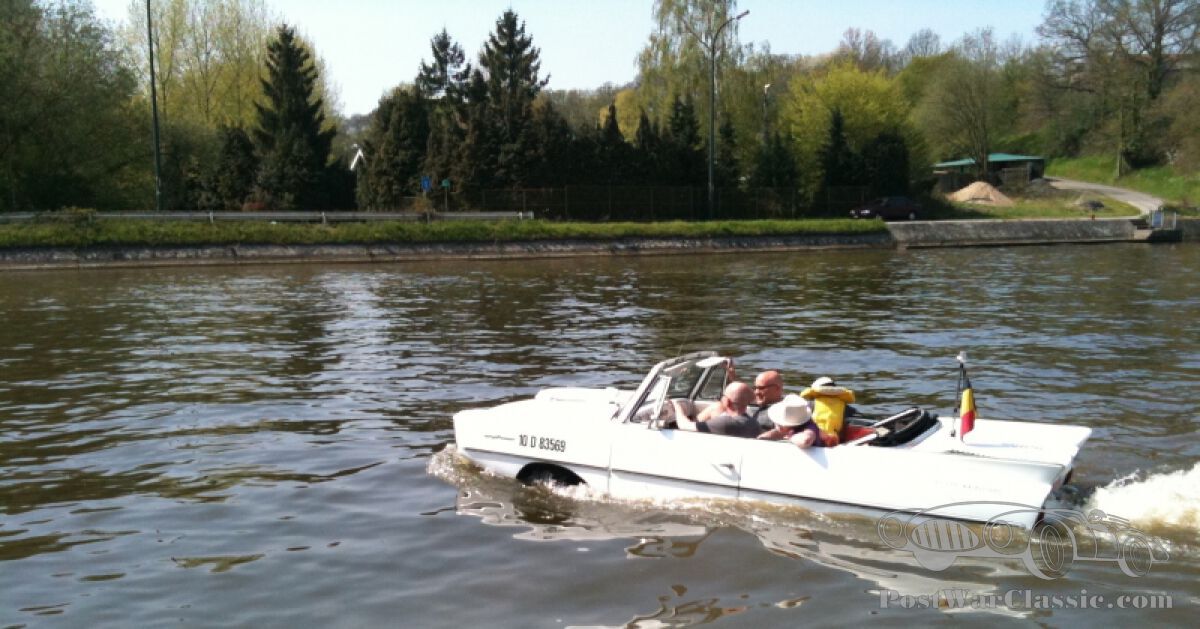


Clickbait on PostWarClassic? Well, it's not because we're into old stuff that we don't adopt the new (even if slightly despicable) ways to lure the curious passer-by to our website with a tempting title! Today's subject: the Amphicar 770. Ahoy!
1. Let's start off by saying that of all the amphibious vehicles, the Amphicar is the boat that drives the best, while of all the cars it's the one that sails best. Good luck beating that combination!
2. The man who designed the Amphicar, Hans Trippel, also designed the gullwing doors of the Mercedes-Benz 300SL. Earlier on, he was also involved in the design of VW’s Schwimmwagen, but that's a tad more obvious.
3. On land, its speedometer goes all the way to 90mph. Let's just say Amphicars are as optimistic as their owners. 0-60mph can be achieved in 43 seconds, but as the optimistic Amphicarist would say: "Does your boat even achieve 60mph on land?"
4. The gearbox, designed by Hermes, is actually based on that of a Porsche 356 with most of the internals interchangeable. Of course, a Porsche 356 doesn't have a pair of reversible propellers at the rear. It’s about time VW upgraded the Schwimmwagen to Porsche level, no?
5. There is no rudder! To steer the car in the water, you simply turn the front wheels as you would on the road. It works pretty well, although making a U-turn on a narrow river can be tricky. Luckily, the paddle was a period option!
6. All joking aside, the Amphicar is perfectly watertight. Before delivery, every car had to pass a waterproof test in a pool. To ensure that the Amphicar keeps floating, you have to close the plug that you can use to drain the chassis, lock the doors and the bonnet, and switch on the bilge pump. If you've got all of that covered, you're good to go. (Life jackets were also a period option).
7. Tired of taking the Eurotunnel or the ferry to go to Beaulieu? Why not take the Amphicar! Amphicars really have crossed the English Channel, traversed the Strait of Gibraltar and made the passage to Southern California’s Catalina Island.
8. Mind you, it might not like the salt water… Also, don't forget that after an Amphicar has been in the water there are 13 grease points needing tender loving care, some of which require removing the rear seats.
9. As soon as you're on the water, the Amphicar is technically no longer a car but a boat, so it needs to follow all rules that apply to boats. Under which flag are you sailing, Captain?
10. Rusty body parts needing replacement will need some perseverance to track down. But mechanically it’s all rather straightforward. Apart from the Porsche transmission bits, the rear-mounted four-cylinder engine is a Triumph Herald-item while Mercedes-Benz supplied the suspension and brakes.
(Words and pictures Vincent Mahy, drawing Eagle magazine)
Originally published on November 6, 2017
Publié:
mercredi novembre 10th, 2021
Facebook
LinkedIn
Twitter
WhatsApp
Email
Copy
Commentaires
Carl Belken
19 Juillet 2019, 04:03
They did pretty well as long as they stayed close to shore BUT, they got in trouble when they went out a bit further. The Missouri River had quite a bit of current to it in that particular flood. The Amphicar did not handle it well and it's operator soon had it back on shore, then left town never to be seen again.
They do well in still waters. They are steered by speeding one prop up and slowing the other down.