Le magazine et marché mondial pour les passionnés de voitures classiques, par des passionnés.
Le magazine et marché mondial pour les passionnés de voitures classiques, par des passionnés.


Faites votre choix:
- Voir les voitures
-
Marque >>
-
Année >>
-
-
Catégorie >>
- Voir les motos
-
Année >>
-
- Voir les pièces et plus
-
Marque de la voiture >>
-
Constructeur >>
-
Catégorie >>
-
Pays


Les annonces; à vendre toutes voitures classique
Aperçu d’annonces associées à cette annonce 1948 Jaguar Mk IV 3½ litre
-

1995 Jaguar XJS Celebration Convertible | Windsorview Lakes 16th July 2022 Sale | Historics Auctioneers
1975 saw the launch of the Jaguar XJS. In a year that Margaret Thatcher was made the leader of the Conservative Party and petrol was 70 pence per gallon, the new grand tourer from Jaguar was introduced as the replacement for the iconic E-Type. During an astonishing build run of 21 years, 115,413 units were produced by the Coventry manufacturer at t..JaguarXJS Celebration ConvertibleVENDU -
2010 Jaguar XKR '75' Edition | Windsorview Lakes 16th July 2022 Sale | Historics Auctioneers
The XK8 was launched in 1996 to replace the XJ-S. Two body styles were produced, a coupé and a convertible and the car was the first in the Jaguar line-up to use Jaguar's newly developed V8 engine. In 2000, the supercharged XKR was added to the range. This produced a staggering 503 horsepower, a subtle rear spoiler, wire mesh front grille and red e..JaguarXKR '75' EditionVENDU -
1970 Jaguar E-Type Series II 2+2 Fixedhead Coupé | Windsorview Lakes 16th July 2022 Sale | Historics Auctioneers
Launched, initially as a grand tourer in two-seater coupé form, the Jaguar E-Type, with its sleek lines, was a revelation in 1961, especially with respect to its top speed of 150mph. In 1968, several revisions were introduced, these being, open headlights without the earlier glass covers, a wrap-around rear bumper, re-positioned and larger front in..JaguarE-Type Series II 2+2 Fixedhead CoupéVENDU -
1993 Jaguar XJ12 Lister | Windsorview Lakes 16th July 2022 Sale | Historics Auctioneers
The Jaguar XJ40 was manufactured between 1986 and 1994. Officially unveiled on 8th October 1986 it was an all-new redesign of the XJ to replace the Series III, although the two model ranges were sold concurrently until the Series III was discontinued in 1992. Lister Cars Limited took the standard XJ12 and offered a comprehensive range of upgrades i..JaguarXJ12 ListerVENDU -
1969 Jaguar E-Type SII Roadster | Windsorview Lakes 16th July 2022 Sale | Historics Auctioneers
There is little doubt that the advent of Jaguar’s E -Type revolutionised the motoring world and sent the press into raptures, the penmanship that created such exquisite lines was truly gifted. This three-dimensional beauty, however, was complemented by a fabulous double-overhead cam, six-cylinder engine that powered this lithe, taut creature comfor..JaguarE-Type SII RoadsterVENDU -
1950 Jaguar Mk. V Saloon (2½ litre) | Windsorview Lakes 16th July 2022 Sale | Historics Auctioneers
Supplied new by main agents Boorers of Worthing on 21st April 1950 and sold to Mr E. C. Pearson Esq of Cromwell Road, Hove, East Sussex. Finished in black coachwork with tan leather hides, this right hand drive ‘home market’ example was one of only 1481 Mk. V 2 ½ Litre saloons built in right hand drive from the total Jaguar MK. V production of 10,4..JaguarMk. V Saloon (2½ litre)VENDU -
1947 Jaguar Mk. IV Saloon | Windsorview Lakes 16th July 2022 Sale | Historics Auctioneers
The 1945-1948 Jaguar Mk. IV was Jaguar's first car after World War II and were essentially continuations of the 1938-39 models. Very few of these cars were built for the right hand drive markets as steel was being rationed for goods for export. The origin of the name is rather odd since, back in 1948, there had been no Mk. I to IV Jaguars; the Mk. ..JaguarMk. IV SaloonVENDU -
1966 Jaguar Mk. II (3.4 Litre) | Windsorview Lakes 16th July 2022 Sale | Historics Auctioneers
Synonymous with the swinging `60s and the hit TV Series Inspector Morse, the Mk. II was undoubtedly the most admired Saloon to emanate from Jaguar's hallowed Browns Lane factory. Featuring notably slimmer roof pillars than its Mk. I predecessor, the immortal Mk. II was as airy on the inside as it was elegant on the outside. The interior was quintes..JaguarMk. II (3.4 Litre)VENDU -
1964 Jaguar Mk. II (3.8 Litre) | Windsorview Lakes 16th July 2022 Sale | Historics Auctioneers
The Jaguar Mk. II was a medium sized saloon built from 1959 to 1967 as a successor to the 2.4 and 3.4 litre models. The Mk. II was handsome, powerful, and good handling saloon which was offered with a choice of three six-cylinder twin cam engines; 2.4 litre, 3.4 litre or 3.8 litre. After the appreciation of the Mk. I, Jaguar's successor was well re..JaguarMk. II (3.8 Litre)VENDU -
1968 Jaguar 240 | Windsorview Lakes 16th July 2022 Sale | Historics Auctioneers
The lineage of the Mk. II can be directly traced back to its predecessor, the 2.4 saloon or Mk. I as it would come to be known in later years. This sporting saloon, designed to fill the gap in Jaguar's range between the XK sports and the voluminous Mk. VII, entered the market in 1956. Power came from the legendary XK straight six, twin cam engine i..Jaguar240VENDU


En promo
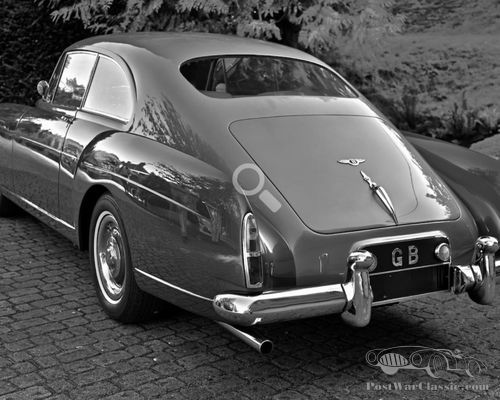
1957 Bentley S1 Fastback par H.J. Mulliner.
Bentley S1 Fastback by H.J. Mulliner – 1957.Exemplaire récemment restauré, primé à plusieurs concours, présenté dans un état proche du neuf...
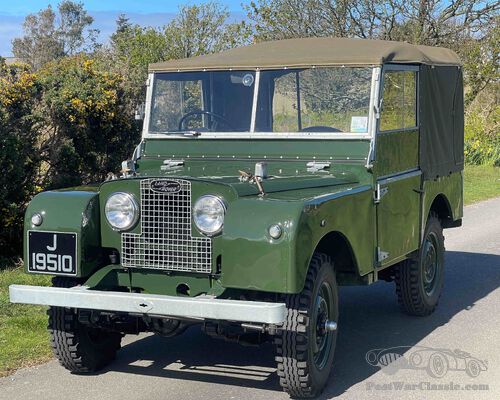
1952 Land Rover Series 1
Spécifications techniques :Marque et modèle : Land Rover Series !Année : 1952Plaque d'immatriculatio..
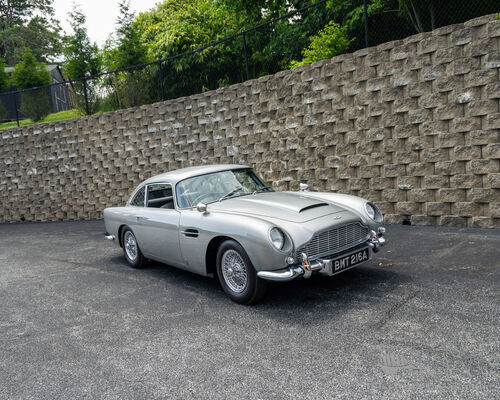
2020 Aston Martin DB5 Goldfinger Continuation
Proposée aux enchères par RM Sotheby's lors de The Monterey Auction, du 13 au 15 août 2026. Estimation : 1 000 000 à 1 500 000 USD