Le magazine et marché mondial pour les passionnés de voitures classiques, par des passionnés.
Le magazine et marché mondial pour les passionnés de voitures classiques, par des passionnés.


Faites votre choix:
- Voir les voitures
-
Marque >>
-
Année >>
-
-
Catégorie >>
- Voir les motos
-
Année >>
-
- Voir les pièces et plus
-
Marque de la voiture >>
-
Constructeur >>
-
Catégorie >>
-
Pays


Les annonces; à vendre toutes voitures classique
Aperçu d’annonces associées à cette annonce 1948 Jaguar Mk IV 3½ litre
-

1998 Jaguar XK8 Coupé | Ascot Racecourse 12th March 2022 Sale | Historic Auctioneers
Jaguar was founded as the Swallow Sidecar Company by Sir William Lyons in 1922, originally making motorcycle sidecars before developing passenger cars. The name was changed to Jaguar after World War II to avoid the unfavourable connotations of the SS initials. Sale to BMC happened in 1966, which in 1968 merged with Leyland Motor Corporation and bec..JaguarXK8 CoupéVENDU -
1990 Jaguar XJS Convertible | Ascot Racecourse 12th March 2022 Sale | Historic Auctioneers
1975 saw the launch of the Jaguar XJS. In a year that Margaret Thatcher was made the leader of the Conservative Party and petrol was 70p/gallon, the new grand tourer from Jaguar was introduced as the replacement for the iconic E-Type. During an astonishing build run of 21 years, 115,413 units were produced by the Coventry manufacturer at their worl..JaguarXJS ConvertibleVENDU -
1965 Jaguar Mk. II Saloon (3.8 Litre, M/OD) | Ascot Racecourse 12th March 2022 Sale | Historic Auctioneers
Arguably one of the most famous Big Cats from Browns Lane, these four-door saloons certainly did not pull any punches. Equipped with the same engine as Jaguar’s legendary E-Type and good for 123mph, they were rightly chosen by both Her Majesty’s Constabulary and, often, the focus of their attention as well; ‘four up and a boot full of swag’. Speed..JaguarMk. II Saloon (3.8 Litre, M/OD)VENDU -
1947 Jaguar Mk. IV SE (1.5 Litre) | Ascot Racecourse 12th March 2022 Sale | Historic Auctioneers
The 1945-1948 Jaguar Mk. IV was Jaguar's first car after World War II and were essentially continuations of the 1938-39 models. Very few of these cars were built for the righthand drive markets as steel was being rationed for goods for export. The origin of the name is rather odd since, back in 1948, there had been no Mk. I to IV Jaguars; the Mk. I..JaguarMk. IV SE (1.5 Litre)VENDU -
2003 Jaguar XJ8 Sport | Ascot Racecourse 12th March 2022 Sale | Historic Auctioneers
The first XJ was launched in 1968 and the designation has been used for successive Jaguar flagship models ever since. The original model was the last Jaguar saloon to have had the input of Sir William Lyons, the company's founder. With the introduction of the X308 generation in 1997 came a switch from the 'XJ6' nomenclature to 'XJ8', reflecting the..JaguarXJ8 SportVENDU -
1989 Jaguar XJS Convertible | Ascot Racecourse 12th March 2022 Sale | Historic Auctioneers
In 1975, the Jaguar E-Type finally gave way to an all new and more efficient Jaguar, the Jaguar XJ-S. This new luxury grand tourer, although never quite having the same sporting image as the E-Type, was actually more aerodynamic with the final example leaving the production line on 4th April 1996; at that stage 115,413 units had been manufactured d..JaguarXJS ConvertibleVENDU -
1969 Jaguar E-Type Series II Roadster (4.2 Litre) | Ascot Racecourse 12th March 2022 Sale | Historic Auctioneers
From its launch in 1961 to the end of its production in 1975, the Jaguar E-Type went from design revelation to motoring icon in a generation. Based on Jaguar’s three time Le Mans winning D-Type and known internationally for its beautiful sleek lines and a top speed of 150mph, this revolutionary car had three significant series changes during its fo..JaguarE-Type Series II Roadster (4.2 Litre)VENDU -
1964 Jaguar Mk. II Saloon (3.8 litre) | Ascot Racecourse 12th March 2022 Sale | Historic Auctioneers
The Jaguar Mk. II was a medium sized saloon built from 1959 to 1967 as a successor to the 2.4 and 3.4 litre models. The Mk. II was handsome, powerful, and good handling saloon which was offered with a choice of three six-cylinder twin cam engines; 2.4 litre, 3.4 litre or 3.8 litre. After the appreciation of the Mk. I, Jaguar's successor was well re..JaguarMk. II Saloon (3.8 litre)VENDU -
1971 Jaguar E-Type Series III Fixedhead Coupé | Ascot Racecourse 12th March 2022 Sale | Historic Auctioneers
By the mid-1960s, the Jaguar E-Type was appealing to the man with a young family but who were restricted by the size of the current Jaguar E-Type Coupé and its open topped sibling. This prompted Jaguar to offer a third option in the form of a 2+2 Coupé. By adding nine inches to the wheelbase and two inches in height, it was then possible to fit a r..JaguarE-Type Series III Fixedhead CoupéVENDU -
1972 Jaguar E-Type Series III Roadster | Ascot Racecourse 12th March 2022 Sale | Historic Auctioneers
The E-Type Series III was introduced in 1971, with a new 5.3 litre, V12 engine, uprated brakes, and standard power steering. Optionally, an automatic transmission, wire wheels and air conditioning were available. The brand new V12 engine produced 272bhp, had more torque, and a 0-60mph acceleration of less than seven seconds, which was phenomenal fo..JaguarE-Type Series III RoadsterVENDU


En promo
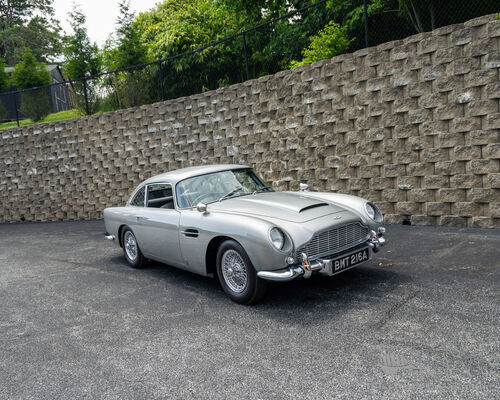
2020 Aston Martin DB5 Goldfinger Continuation
Proposée aux enchères par RM Sotheby's lors de The Monterey Auction, du 13 au 15 août 2026. Estimation : 1 000 000 à 1 500 000 USD
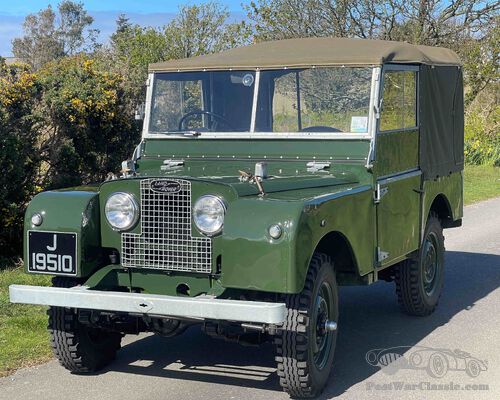
1952 Land Rover Series 1
Spécifications techniques :Marque et modèle : Land Rover Series !Année : 1952Plaque d'immatriculatio..
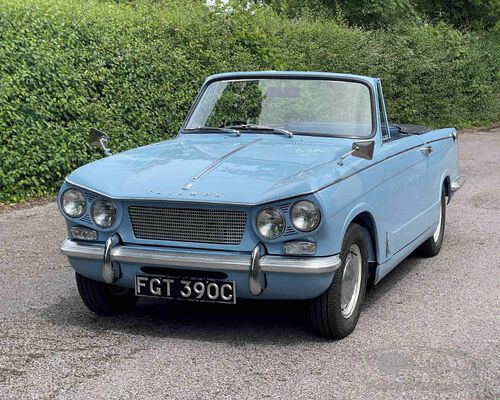
Triumph Vitesse 6 Convertible
Caractéristiques techniquesMarque et modèle : Triumph Vitesse 6 ConvertibleAnnée : 1965Immatriculation : Royaume-Uni