Le magazine et marché mondial pour les passionnés de voitures classiques, par des passionnés.
Le magazine et marché mondial pour les passionnés de voitures classiques, par des passionnés.


Faites votre choix:
- Voir les voitures
-
Marque >>
-
Année >>
-
-
Catégorie >>
- Voir les motos
-
Année >>
-
- Voir les pièces et plus
-
Marque de la voiture >>
-
Constructeur >>
-
Catégorie >>
-
Pays



Les annonces; à vendre toutes voitures classique
Aperçu d’annonces associées à cette annonce 1948 Jaguar Mk IV 3½ litre
-

Jaguar XK 140 FHC
Jaguar XK 140 FHC Special Equipment, beautiful ready to use, excellent car for racing the Mille Miglia. British racing green with beige leather interior. Mounted system with front and rear disc brakes. Also installed are accessories of the SE (Special Equipment) version such as dual exhaust, chromed spoke rims, fog lights.- THE EXPOSED PR..1955JaguarXK 140 FHCVENDULocation: Italie -
1966 Jaguar S-Type (3.4 litre) | Historics Auctioneers
Produced from 1963 to 1968, the Jaguar S-Type was technically a more sophisticated development of the Jaguar Mk. II, offering buyers a more luxurious alternative. It was available with either 3.4 or 3.8 litre XK engines and featured longer rear bodywork among other styling and interior changes. Despite its extra weight, the S-Type's independent rea..1966JaguarS-Type (3.4 litre)VENDU -
1972 Jaguar E-Type Series III Roadster | Historics Auctioneers
In March 2008, the Jaguar E-Type ranked first in the Daily Telegraph's list of the '100 most beautiful cars' of all time. It was initially designed and shown to the public as a grand tourer in two-seater coupé form and as convertible. The model was made in three distinct versions which are now generally referred to as 'Series I', 'Series II' and 'S..1972JaguarE-Type Series III RoadsterVENDU -
1958 Jaguar Mk. I (3.4 litre) | Historics Auctioneers
Launched in 1955, the Mk. I extended Jaguar's domination of the high-performance car market in Britain, slotting neatly into the Coventry firm's range alongside the big Mk. VII M saloon and the XK140 sports car. The medium size newcomer broke new ground for Jaguar, being its first model to employ unitary construction of the chassis/body. Jaguar's e..1958JaguarMk. I 3.4VENDU -
1960 Jaguar Mk. II (3.8 litre) | Historics Auctioneers
Built between 1959 and 1967 the Jaguar Mk. II is a medium sized saloon car constructed in Coventry as the successor to the Jaguar 2.4 litre and 3.4 litre models manufactured between 1957 and 1959. These retrospectively became known as the Jaguar Mk. I following the release of the Mk. II in 1959. Adhering to Sir William Lyons' maxim of ‘grace, pace ..1960JaguarMk. II (3.8 litre)VENDU -
1970 Jaguar E-Type Series II Coupé | Historics Auctioneers
From its launch in 1961 to the end of its production in 1975, the Jaguar E-Type went from design revelation to motoring icon in a generation. Based on Jaguar’s three time Le Mans winning D-Type and known internationally for its beautiful sleek lines and a top speed of 150mph, this revolutionary car had three significant series changes during its 14..1970JaguarE-Type Series II CoupéVENDU -
1959 Jaguar XK150 Drophead Coupé | Historics Auctioneers
Despite having a family resemblance to the XK120 and XK140, the XK150 was radically modernised. A one-piece windscreen replaced the split screen and the wing line no longer dropped as much over the doors. The bonnet was widened, opened down to the wings and on the roadster, the bulkhead was moved back four inches to make the bonnet longer. In the i..1959JaguarXK150 Drophead CoupéVENDU -
1954 Jaguar XK120 Roadster ‘Fast road’ | Historics Auctioneers
One of the unassailable leaders in the XK field is Guy Broad. Indeed, any car with a service history or works undertaken by this company will certainly command a premium. It is little surprise that this company his formed part of the development of this car these cars over the years and significant paperwork exist here to support works undertaken. ..1954JaguarXK120 Roadster ‘Fast road’VENDU -
1987 Jaguar XJ-SC (5.3 litre) | Historics Auctioneers
That Jaguar's XJS will become a 'bona fide' classic is beyond doubt. Launched in 1975, its 21 year production life was a testimony to the excellence of its basic design. With all round independent, coil sprung suspension, power assisted rack and pinion steering and disc brakes, its excellent ride/handling balance was justly praised by the contempor..1987JaguarXJ-SC (5.3 litre)VENDU -
1964 Jaguar Mk. II (3.4 litre) | Historics Auctioneers
The lineage of the Mk. II can be directly traced back to its predecessor, the 2.4 saloon or Mk. I as it would be retrospectively known in later years. Traditional Jaguar buyers would not feel alienated by the new offering from Coventry as the interior was up to their usual standards with leather and walnut being the order of the day. With 112bhp av..1964JaguarMk. II (3.4 litre)VENDU


En promo
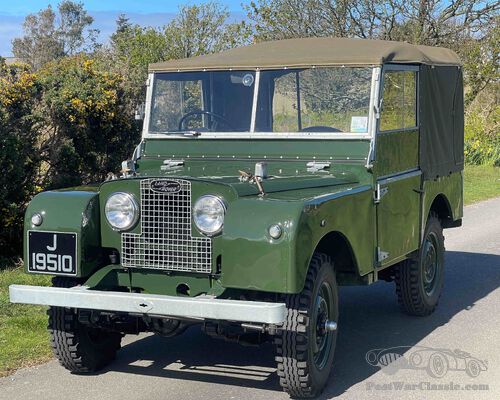
1952 Land Rover Series 1
Spécifications techniques :Marque et modèle : Land Rover Series !Année : 1952Plaque d'immatriculatio..
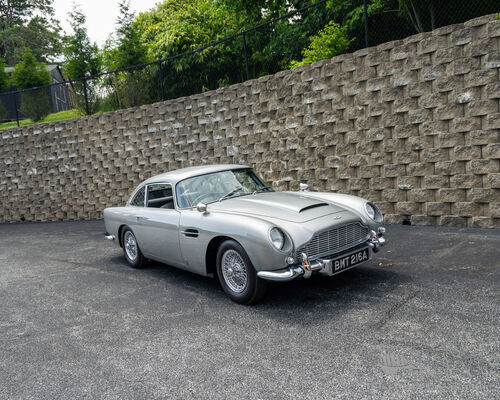
2020 Aston Martin DB5 Goldfinger Continuation
Proposée aux enchères par RM Sotheby's lors de The Monterey Auction, du 13 au 15 août 2026. Estimation : 1 000 000 à 1 500 000 USD
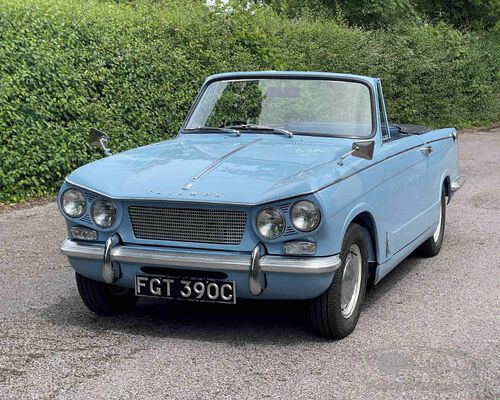
Triumph Vitesse 6 Convertible
Caractéristiques techniquesMarque et modèle : Triumph Vitesse 6 ConvertibleAnnée : 1965Immatriculation : Royaume-Uni