Le magazine et marché mondial pour les passionnés de voitures classiques, par des passionnés.
Le magazine et marché mondial pour les passionnés de voitures classiques, par des passionnés.


Faites votre choix:
- Voir les voitures
-
Marque >>
-
Année >>
-
-
Catégorie >>
- Voir les motos
-
Année >>
-
- Voir les pièces et plus
-
Marque de la voiture >>
-
Constructeur >>
-
Catégorie >>
-
Pays



Les annonces; à vendre toutes voitures classique
Aperçu d’annonces associées à cette annonce 1948 Jaguar Mk IV 3½ litre
-

1965 Jaguar 240 | Ascot Racecourse Sale | 27 May 2023
The lineage of the Mk. II can be directly traced back to its predecessor, the 2.4 saloon or Mk. I as it would come to be known in later years. This sporting saloon, designed to fill the gap in Jaguar's range between the XK sports and the voluminous Mk. VII, entered the market in 1956. Power came from the legendary XK straight six, twin cam engine i..1965Jaguar240VENDU -
1998 Jaguar XKR Coupé | Ascot Racecourse Sale | 27 May 2023
The XK8 is a grand tourer car that was launched in 1996 and was the first generation of a new XK series available in either coupé or convertible body styles and with the new 4.0 litre Jaguar AJ-V8 engine. The 1998 XKR was introduced with a supercharged version of the engine. Both the XK8 and XKR are electronically limited to a maximum of 155mph, th..1998JaguarXKR CoupéVENDU -
1968 Jaguar E-Type Series I 2+2 Coupé | Ascot Racecourse Sale | 27 May 2023
The Jaguar E-Type Series I 2+2 was designed to be a more practical version of the legendary E-Type, with a longer wheelbase and additional interior space. It was produced from 1966 to 1970, and it featured a 4.2 litre inline-six engine that produced 265 horsepower. One of the most notable features of the 1968 Jaguar E-Type Series I 2+2 is its sleek..1968JaguarE-Type Series I 2+2 CoupéVENDU -
1956 Jaguar XK140 SE Fixedhead Coupé | Ascot Racecourse Sale | 27 May 2023
The Jaguar XK140 SE Fixedhead Coupé was a sports car produced by Jaguar Cars between 1954 and 1957. It was an updated version of the previous model the XK120, with several improvements including more interior space, improved brakes and steering, and a revised suspension system. The SE version was even more powerful, with a C-type cylinder head and ..1956JaguarXK140 SE Fixedhead CoupéVENDU -
1961 Jaguar E-Type Series I Roadster Flat Floor | Ascot Racecourse Sale | 27 May 2023
Introduced in 3.8 litre form in 1961, the Jaguar E-Type caused a sensation when it appeared with instantly classic lines and 150mph top speed. While, inevitably, the car's stupendous straight-line performance and gorgeous looks grabbed the headlines, there was a lot more to the E-Type beneath the skin. The newcomer's design owed much to that of the..1961JaguarE-Type Series I Roadster Flat FloorVENDU -
1964 Jaguar E-Type Series I Coupé | Ascot Racecourse Sale | 27 May 2023
Introduced in 3.8 litre form in 1961, the Jaguar E-Type caused a sensation when it appeared with instantly classic lines and 150mph top speed. While, inevitably, the car's stupendous straight-line performance and gorgeous looks grabbed the headlines, there was a lot more to the E-Type beneath the skin. The newcomer's design owed much to that of the..1964JaguarE-Type Series I CoupéVENDU -
1971 Jaguar XK140 by Aristocat | Ascot Racecourse Sale | 27 May 2023
Built with Jaguar's written permission, the Aristocat uses all Jaguar components housed in a steel spaceframe chassis. For ease of build the Aristocat uses the XJ Series suspension, un-modified, resulting in the car being five inches wider than the XK120 or XK140, but only one inch wider than the XK150. The additional width, added down the centre o..1971JaguarXK140 by AristocatVENDU -
1994 Jaguar XJS Convertible | Ascot Racecourse Sale | 27 May 2023
The Jaguar XJS Convertible, which first appeared in 1988, was considerably more than just a coupé with the roof removed. The earlier 'T'-top cabriolet paved the way as the first open Jaguar since the demise of the E-Type in 1975 but this was to be the first full convertible and a strengthened sub-frame was employed in order to alleviate scuttle sha..1994JaguarXJS ConvertibleVENDU -
1960 Jaguar MK2 3.8 | Finarte Collector Cars auction | June 5, 2023
chassis no. 210500, engine no. LA16669 • According to Sir William Lyons' dictum: "grace, pace and space".• Matching numbers.• Excellent condition. Restored.• Classic livery: British Racing Green/natural leather, wire wheels and Motolita steering wheel.• Certified by the Registro Fiat Italiano. After the ..1960JaguarMk2 3.8VENDULocation: Italie -
1957 Jaguar XK140 | Finarte Collector Cars auction | June 5, 2023
1957 JAGUAR XK 140 chassis no. 8819209 • Complete restoration.• Excellent conditions, perfect efficiency.• Type C (Competition) head.• Left Hand Drive.• Spanish documents in order and up to date. The XK 140 is the model that replaced, in 1954, the XK 120, improving it and perfecting the mod..1957JaguarXK140VENDULocation: Italie


En promo
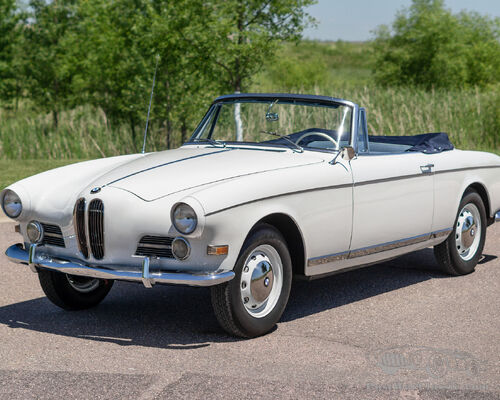
BMW 503 Cabriolet (V8) de 1957, 1 des 13 exemplaires construits pour le marché américain, exemplaire d'origine.
1957 BMW 503 Cabriolet Série 1 Moteur V8 en aluminium d'origine # correspondant Carrosserie en aluminium d'origine avec estampilles d'usine 1 des..
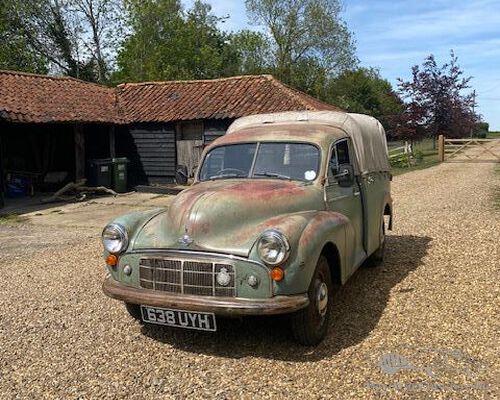
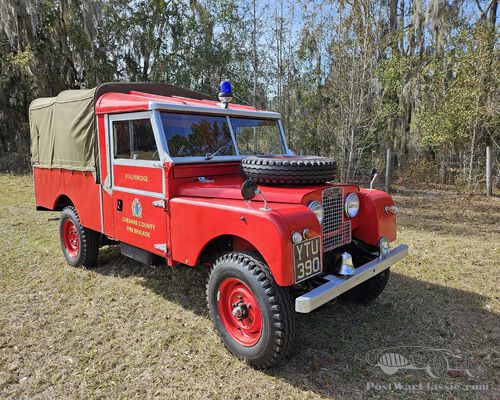
1957 Series 1 Land Rover
Betsy a été utilisée par le Cheshire Fire Service (Royaume-Uni) de 1957 à 1975. Elle fut affectée aux casernes de Hazel Grove et de Stalybridge. El..