Le magazine et marché mondial pour les passionnés de voitures classiques, par des passionnés.





Les annonces; à vendre toutes voitures classique
Aperçu d’annonces associées à cette annonce Jensen Interceptor III Cabriolet conduite à gauche.
-

1973 Jaguar E-Type Series III Roadster | Mercedes Benz Worlds Brooklands sale - November 2023 | Historics Auctioneers
The E-Type Series III was introduced in 1971, with a new 5.3 litre, V12 engine, uprated brakes, and power steering as standard. Optionally, an automatic transmission, wire wheels and air conditioning were available. The brand new V12 engine produced 272bhp, had increased torque, and a 0-60mph time of less than seven seconds, which was phenomenal fo.. -
1974 Citroën DS 23 Safari | La vente en Mercedes Benz Worlds Brooklands - novembre 2023 | Historics Auctioneers
Après 18 ans de développement secret, la DS 19 est présentée le 5 octobre 1955 au Salon de l'automobile de Paris. Dans les 15 premières minutes du salon, 743 commandes ont été enregistrées et les commandes pour le premier jour se sont élevées à 12 000 voitures. Pour une France encore en pleine reconstruction après les ravages de la Seconde Guerr.. -
1972 MG B GT | Mercedes Benz Worlds Brooklands sale - November 2023 | Historics Auctioneers
The MGB was launched in May 1962 to replace the MGA. Introduced as a four-cylinder roadster, a coupé with 2+2 seating was added in 1965 with production continuing until October 1980. The MGB GT sported a ground-breaking design by Pininfarina with the launch of its sporty 'hatchback' style. By combining the sloping rear window with the rear deck lid.. -
1976 Porsche 911 Targa ‘Restomod’ | Mercedes Benz Worlds Brooklands sale - November 2023 | Historics Auctioneers
The Porsche 911 was developed as a much more powerful, larger, more comfortable replacement for the Porsche 356, the company's first model and essentially a sporting evolution of the Volkswagen Beetle. The new car made its public debut at the 1963 Internationale Automobil-Ausstellung, better known to English speakers as the Frankfurt Motor Show. Af.. -
1976 Alfa Romeo GT Junior | Mercedes Benz Worlds Brooklands sale - November 2023 | Historics Auctioneers
Mention Alfa Romeos from the 1960s and 1970s and what usually springs to mind is the marque’s 105 Series Coupé, designed by Giorgetto Giugiaro of Bertone and considered to be one of his greatest designs. Not only as one of the best looking and handling classic saloon cars of the period, but the advanced specification, with its five-speed gearbox, a.. -
1977 Porsche 911 ‘Restomod’ (3.0 litre) | Mercedes Benz Worlds Brooklands sale - November 2023 | Historics Auctioneers
The Porsche 911 is the flagship car of the German manufacturer. It has a distinctive design, rear-engined, with independent rear suspension, an evolution of the swing axle on the Porsche 356. Since its introduction in 1963, the 911 has undergone continuous development although the basic concept has remained little changed. Throughout its lifetime, .. -
1975 Aston Martin V8 Series III | Mercedes Benz Worlds Brooklands sale - November 2023 | Historics Auctioneers
Completely handbuilt and requiring over 1,200 man-hours to finish, these motorcars are every bit the gentleman’s sporting tourer. Although the DBS was the pre-curser, it shared the same V8 engine until the six-cylinder engine option version was phased out in 1972. It benefited from heavier, ventilated disc-brakes, air conditioning, fatter tyres and.. -
1975 Maserati Merak SS | Mercedes Benz Worlds Brooklands sale - November 2023 | Historics Auctioneers
The Maserati Merak was introduced in 1972, essentially a lighter version of the Maserati Bora. It substituted an all-new Maserati designed quad-cam, three litre, V6 motor for the Bora's larger V8; resulting not only in a lower cost but with room for a small back seat and better handling due to lower weight and a better front/rear weight distributio.. -
1968 Jensen Interceptor | Mercedes Benz Worlds Brooklands sale - November 2023 | Historics Auctioneers
The Jensen Interceptor was launched in 1966, utilising an all steel bodyshell, breaking away from the company's traditional method of construction that used GRP (Glass Reinforced Plastic). Designed by Carrozzeria Touring, the early cars were built by Vignale before production eventually was carried out at the Jensen works in West Bromwich. The imp.. -
1977 Alfa Romeo Alfaholics Spider-R | Mercedes Benz Worlds Brooklands sale - November 2023 | Historics Auctioneers
A superb bespoke open-top performance car, known as the world’s fastest Alfa Spider, and featuring new or refurbished parts throughout after a recent full engine and gearbox rebuild. Powered by an uprated and fuel-injected, MoTec ECU controlled Alfaholics 2.0 litre Twin Spark engine, producing 216bhp, coupled to a five-speed fast road specification..



En promo
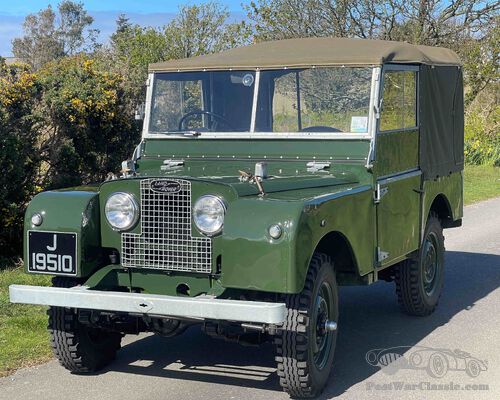
1952 Land Rover Series 1
Spécifications techniques :Marque et modèle : Land Rover Series !Année : 1952Plaque d'immatriculatio..
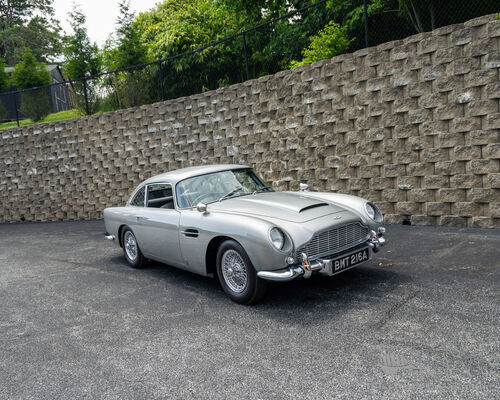
2020 Aston Martin DB5 Goldfinger Continuation | RM Sotheby's | The Monterey Auction
To Be OFFERED AT AUCTION at RM Sothebys' The Monterey Auction event, 13 - 15 August 2026. $1,000,000 - $1,500,000 USD One of 25 examples co..
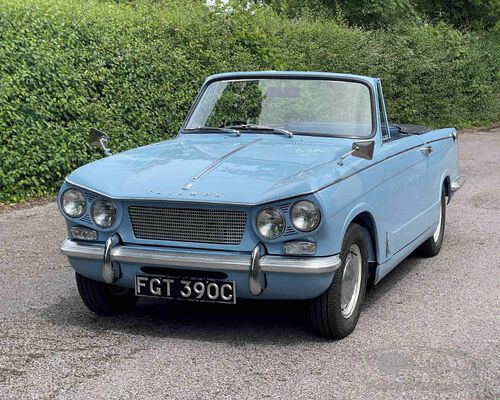
Triumph Vitesse 6 Convertible
Technical SpecificationsMark & Model: Triumph Vitesse 6 ConvertibleYear: 1965Registration plate: UK registered