Le magazine et marché mondial pour les passionnés de voitures classiques, par des passionnés.




Les annonces; à vendre toutes voitures classique
Aperçu d’annonces associées à cette annonce Jaguar C Type
-

1959 GMC 370 ‘Flatbed’ | Historic Auctioneers | Farnborough International | 11th May 2024
The Chevrolet Task Force was Chevrolet's successor to the Advance Design series. The Task Force series ran from late 1955 (second series) through 1959. At GMC dealers, it was called the Blue Chip series. The 1955 second series offered standard options and add-ons such as 12-volt electrical systems, Chevrolet’s first V8 engine since 1915 (265 cubic .. -
1957 Land Rover Series I 107 Pick-Up | Historic Auctioneers | Farnborough International | 11th May 2024
Built between 1949 and 1958, the Series I Land Rover was available in no fewer than five different wheelbase lengths ranging from 80 to 109. The original 1.6-litre petrol engine was soon superseded by a 2.0-litre unit (for 1952) and the company set about developing its own diesel, which was first offered in 1956. Ruggedly built and simple in constr.. -
1957 Land Rover Series I SWB | Historic Auctioneers | Farnborough International | 11th May 2024
In the aftermath of the Second World War, Rover's chief engineer Maurice Wilks used a ‘demobbed' Willys Jeep around his farm in Anglesey and was impressed with its abilities. Eventually, it wore out and he was keen to replace it with a British vehicle, however, nothing remotely similar was available. Coincidentally, his brother Spencer, who was Man.. -
2013 Jaguar F Type 3.0 S Convertible | Historic Auctioneers | Farnborough International | 11th May 2024
The Jaguar F-Type is a series of two-door, two-seater sportscars manufactured by British car manufacturer Jaguar Land Rover under their Jaguar Cars marque since 2013. The car was based on a shortened version of the hugely successful XK platform. It is the so-called spiritual successor to the famous E Type. Launched in 2013, the F Type was an immedi.. -
1958 Mercedes-Benz 190 SL | Historic Auctioneers | Farnborough International | 11th May 2024
Together with the 300 SL, the Mercedes-Benz 190 SL made history at the New York International Motor Sports Show in February 1954 by being the first new production Mercedes-Benz to be unveiled outside of Germany. The striking impression given by the 190 SL, sitting alongside the bigger 300 SL, was neat, sporty and with dashing lines - signatures of .. -
1956 Bentley S1 | Historic Auctioneers | Farnborough International | 11th May 2024
Successor to the R-Type, the Bentley S1 was introduced in 1955 with a whole new chassis; the car's wheelbase had been extended 3 to 123, and the luggage compartment was expanded. The S1 had softer suspension than the R-Type, with electrically controlled rear shock absorbers. Brakes had been improved, and the steering was lighter. This model marked .. -
1974 Jaguar E-Type Series III Roadster | Historic Auctioneers | Farnborough International | 11th May 2024
The Jaguar E-Type was ten years old and needed new life. History repeated itself and it was a huge success when Jaguar debuted its robust new engine in a sports car instead of the saloon for which it was designed. Despite its sports-car heritage, Jaguar depended on saloon vehicles for its survival and had developed its twelve-cylinder engine to pow.. -
1977 Jaguar Series II XJC V12 | Historic Auctioneers | Farnborough International | 11th May 2024
The XJ series of motorcars were the mainstay of Jaguar cars since 1968 and, in fact, was the last motorcar to have any input by Sir William Lyons, its founder. After the series I and II, a relatively short run of two-door XJ coupés with a pillarless hardtop body called the XJ-C were built between 1975 and 1978. The car was actually launched at the .. -
2000 Jaguar XKR Coupé | Historic Auctioneers | Farnborough International | 11th May 2024
The XK8 is a grand tourer car that was launched in 1996 and was the first generation of a new XK series available in either coupé or convertible body styles and with the new 4.0 litre Jaguar AJ-V8 engine. The 1998 XKR was introduced with a supercharged version of the engine. Both the XK8 and XKR are electronically limited to a maximum of 155mph, th.. -
1960 Jaguar XK150 Coupé | Historic Auctioneers | Farnborough International | 11th May 2024
The Jaguar XK150 was manufactured between 1957 and 1961 and despite having a family resemblance to the XK120 and XK140, the XK150 was radically modernised. A one-piece windscreen replaced the split screen and the wing line no longer dropped as much over the doors. The bonnet was widened, opened down to the wings and on the roadster, the bulkhead wa..





En promo
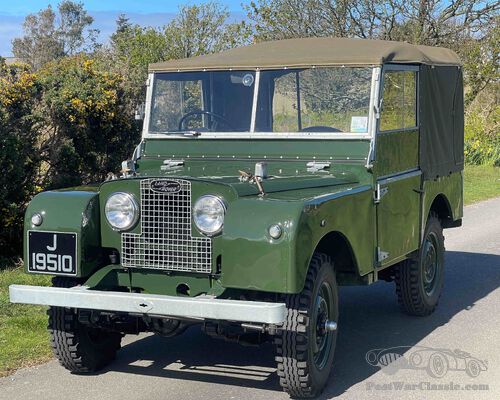
1952 Land Rover Series 1
Spécifications techniques :Marque et modèle : Land Rover Series !Année : 1952Plaque d'immatriculatio..
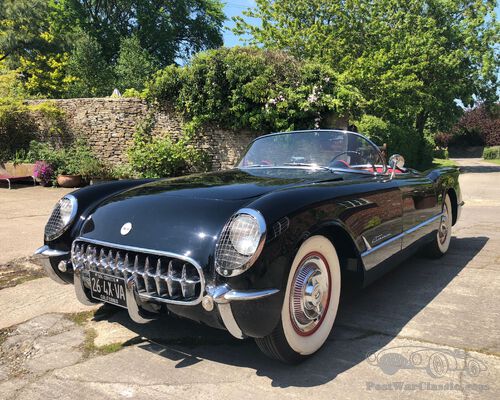
1954 Corvette C1 - SUPER RARE Black!!
Looking for her next lover, my classy 1954 Corvette C1. She's a beautiful sculpture. Never have i had so many adoring comments as when drivi..
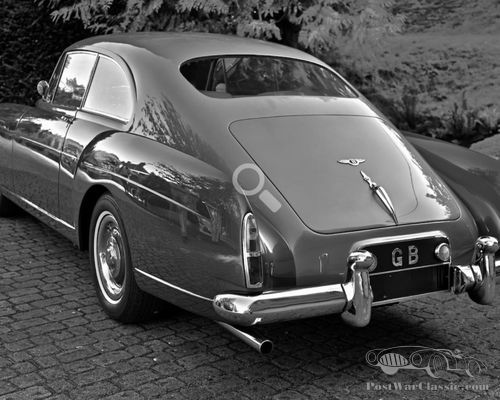
1957 Bentley S1 Fastback par H.J. Mulliner.
Bentley S1 Fastback by H.J. Mulliner – 1957.Exemplaire récemment restauré, primé à plusieurs concours, présenté dans un état proche du neuf...