Le magazine et marché mondial pour les passionnés de voitures classiques, par des passionnés.





Les annonces; à vendre toutes voitures classique
Aperçu d’annonces associées à cette annonce Delahaye 135MS CL Spéciale 1953
-

1952 Avions Voisin C31 Biscooter | Amelia Island Auction | Gooding & Company | March 1, 2024
Following WWII, Gabriel Voisin felt the market was ready for a small vehicle suitable for two passengers that could be driven without a license. With the chassis and bodywork made out of lightweight aluminum, the Biscooter was a low-cost, low-maintenance vehicle. With a basic hood and adjustable windscreen, the minimalist style reflected Voisin’.. -
1948 Delahaye Type 175 GP Recreation | Amelia Island Auction | Gooding & Company | March 1, 2024
Featuring a semi-monocoque chassis, front independent and rear semi-independent suspension, and generously sized, hydraulically actuated Lockheed brakes, Delahaye’s 175 was among the most modern and advanced cars built anywhere in the world upon its 1948 introduction. The 175 utilized a variant of the 135’s Le Mans-proven, overhead-valve straigh.. -
1948 Delahaye Type 135 MS Cabriolet | Amelia Island Auction | Gooding & Company | March 1, 2024
First seen in 1935, Delahaye’s 135 model signaled the exclusive French marque’s intent to imbue their highly regarded luxury cars with more sportiness. History shows this endeavor to have been quite successful, with the 135 securing many important period rally and endurance competition victories, including an outright win at the 1937 Monte Carlo.. -
1958 Ferrari 250 GT Coupe | Amelia Island Auction | Gooding & Company | March 1, 2024
When Pinin Farina’s prototype for a 250 GT Coupe debuted at Geneva in March 1956, it was announced that this model would be produced by its designer and Mario Boano’s carrozzeria would manufacture a limited series of bespoke cabriolets. However, due to what many historians claim was an inadequate production capacity at Pinin Farina, Fer.. -
1957 Porsche 356 A 1500 GS/GT Carrera Speedster | Amelia Island Auction | Gooding & Company | March 1, 2024
In 1955, less than a year after the 356 Speedster model was introduced, Porsche built the first example equipped with the competition-derived four-cam Carrera engine. The result was a brilliant dual-purpose sports car, and the Carrera Speedster continued to be improved and refined over the course of production. For 1957, Porsche began t.. -
1955 Porsche 356 1500 Continental Coupe | Amelia Island Auction | Gooding & Company | March 1, 2024
Named at the suggestion of US importer Max Hoffman, the rare, one-year-only 356 Continental marks a fascinating moment during Porsche’s earliest years in the American marketplace. Unwittingly, Porsche’s marketing efforts attracted the attention of the mighty Ford Motor Company, which had already established the Continental Division as its flagsh.. -
1957 Alfa Romeo Giulietta Spider | Amelia Island Auction | Gooding & Company | March 1, 2024
In the mid-1950s, enthusiasts who were considering purchasing a small, open sports car found themselves presented with a compelling new choice: Alfa Romeo’s Giulietta Spider. It featured gorgeous Pinin Farina styling, twin overhead-cam alloy engine, outstanding ride quality, and weather protection equal to that of more expensive sports cars. Tod.. -
1954 Ferrari 500 Mondial Series I Spider | Amelia Island Auction | Gooding & Company | March 1, 2024
In December 1953, Ferrari unveiled its first four-cylinder production sports car – the 500 Mondial, named in honor of Alberto Ascari’s back-to-back World Championships. Like Ascari’s 500 F2 Monoposto, the Mondial featured a two-liter, twin-cam, four-cylinder engine designed by Aurelio Lampredi. Known internally as the tipo 110, this eng.. -
1957 Mercedes-Benz 300 SL Roadster | Amelia Island Auction | Gooding & Company | March 1, 2024
In March 1957, Mercedes-Benz unveiled the 300 SL Roadster, employing a host of mechanical advancements and stylistic revisions to create a new, open version of the successful Gullwing. Chief among these were a new rear-axle design and a modified space-frame chassis that allowed for conventionally hinged doors. The Roadster offered easier ingress.. -
1954 Cadillac Series 62 Convertible | Amelia Island Auction | Gooding & Company | March 1, 2024
According to former owner John Staluppi, this glamorous 1954 Cadillac Series 62 Convertible was purchased new from Swisher Cadillac of Mansfield, Ohio, by the owner of the local taxi company branch who desired a Cadillac convertible to match the color of his cabs. Four subsequent owners were also from Mansfield, prior to the Cadillac’s acquisiti..



En promo
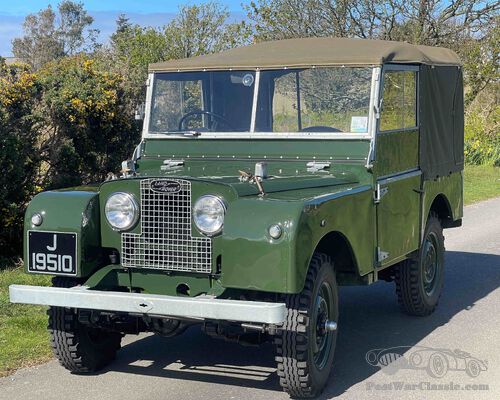
1952 Land Rover Series 1
Spécifications techniques :Marque et modèle : Land Rover Series !Année : 1952Plaque d'immatriculatio..
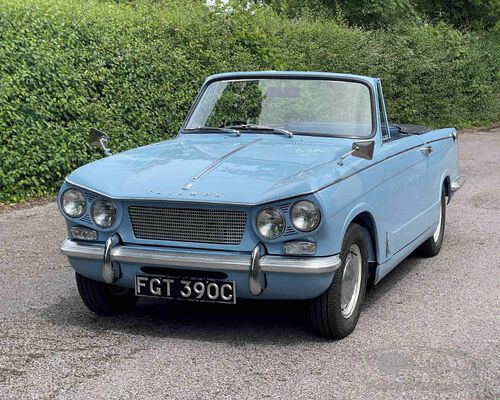
Triumph Vitesse 6 Convertible
Caractéristiques techniquesMarque et modèle : Triumph Vitesse 6 ConvertibleAnnée : 1965Immatriculation : Royaume-Uni
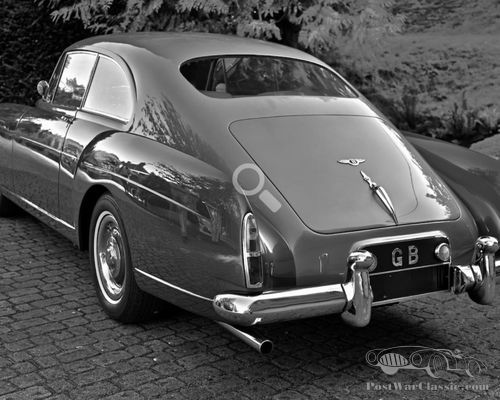
1957 Bentley S1 Fastback par H.J. Mulliner.
Bentley S1 Fastback by H.J. Mulliner – 1957.Exemplaire récemment restauré, primé à plusieurs concours, présenté dans un état proche du neuf...