Le magazine et marché mondial pour les passionnés de voitures classiques, par des passionnés.





Les annonces; à vendre toutes voitures classique
Aperçu d’annonces associées à cette annonce 1972 Citroen DS 23 PALLAS
-

1973 Porsche 911 T Coupe | The Amelia Auction 2024 | Broad Arrow Auctions
Chassis No. 9113102859 Engine No. 6135198 Nineteen seventy-three marked the end of a number of eras at Porsche, even though many didn't notice it at the time. Most notably, all variants of the 911 were about to receive a raft of stylistic and technical changes inside and out for 1974-its first major update since being introduced ten ye.. -
1974 Ferrari 365 GT4 Berlinetta Boxer | The Amelia Auction 2024 | Broad Arrow Auctions
Chassis No. F102AB18171 Engine No. 00230 Transmission No. 432 The first mid-engined road car to bear the Cavallino Rampante badge was a long time in the making, with the development of the 365 GT4 Berlinetta Boxer beginning in the late 1960s and not appearing in showrooms until 1973. This gestation period can be attributed to the.. -
1974 Pontiac Firebird Trans Am Super Duty 455 | Amelia Island Auction | Gooding & Company | March 1, 2024
By 1974, the American muscle car was all but dead due to increasingly stringent emissions regulations that strangled performance, hitting large-displacement cars especially hard. However, there was one holdout for the 1974 model year: the Pontiac Firebird Trans Am Super Duty 455. Although it was equipped with some smog equipment, beneath the Fir.. -
1973 Porsche 911 2.4 S | Amelia Island Auction | Gooding & Company | March 1, 2024
In 1972, Porsche introduced what has come to be regarded as one of its finest variations on the classic 911 platform: the 2.4 S. It featured a 190 hp, fuel-injected flat-six engine, improved type 915 transaxle, and myriad refinements that made the magnificently engineered sports car a well-rounded performer. Just 1,430 S coupes were completed fo.. -
1970 Mercedes-Benz 280 SL | Amelia Island Auction | Gooding & Company | March 1, 2024
As the successor to the legendary 300 SL series built from 1954 to 1962, the W113 SL had enormous shoes to fill. The German automaker shifted the focus of the SL to be more of a volume seller, and the Paul Bracq-designed roadster was hailed as the next great Mercedes-Benz. In addition to having a fuel-injected, inline six-cylinder engin.. -
1965 Citroën DS19 Majesty | Amelia Island Auction | Gooding & Company | March 1, 2024
As early as 1958, Henri Chapron began purchasing complete DS models directly from Citroën, as required, to create special coachwork for them. One variant, the Majesty, featured a higher and more angular roofline than the factory DS, similar to the Concorde, providing increased headroom for the rear passengers and greater interior space. Its purp.. -
1963 Citroën DS19 Concorde | Amelia Island Auction | Gooding & Company | March 1, 2024
In 1955, Citroën introduced the revolutionary DS19 sedan. Despite new coachbuilt cars being few and far between at that time, Henri Chapron made body modifications to a DS19 in 1958, without the endorsement of Citroën. Chapron’s name was synonymous with exquisite coachwork of French marques including Delahaye, Talbot-Lago, and Delage throughout .. -
1963 Citroën DS19 Le Dandy | Amelia Island Auction | Gooding & Company | March 1, 2024
Henri Chapron was a prominent Parisian coachbuilder of Art Deco-style automobiles in the 1930s. Following WWII, the need for such coachwork was diminishing. In 1958, with the introduction of the new Citroën DS, Chapron decided to create hand-built custom bodies without the support of Citroën. Chapron was initially required to purchase complete c.. -
1966 Citroën DS21 Le Leman | Amelia Island Auction | Gooding & Company | March 1, 2024
Following the revolutionary DS19 introduced at the Paris Motor Show in October 1955, Citroën created a successor to the model with the DS21. The 21 improved on the 19 with an increase in power from 75 to 125 hp. Both featured hydropneumatic suspension, allowing the vehicle to operate while balanced on three wheels if necessary. Until the 1950s, .. -
1973 Porsche 911 2.4 T | Amelia Island Auction | Gooding & Company | March 1, 2024
This stunning US-delivery 911 2.4 T was factory-specified in the rare, vibrant color of Dalmatian Blue and nicely optioned, including the Comfort Package and front and rear stabilizer bars. After time in the Pacific Northwest, the Porsche was acquired by enthusiast Charles Coviello of Connecticut. In 2010, Coviello had a restoration performed by..



En promo
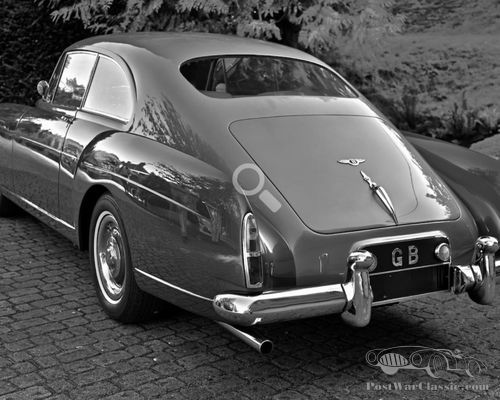
1957 Bentley S1 Fastback par H.J. Mulliner.
Bentley S1 Fastback by H.J. Mulliner – 1957.Exemplaire récemment restauré, primé à plusieurs concours, présenté dans un état proche du neuf...
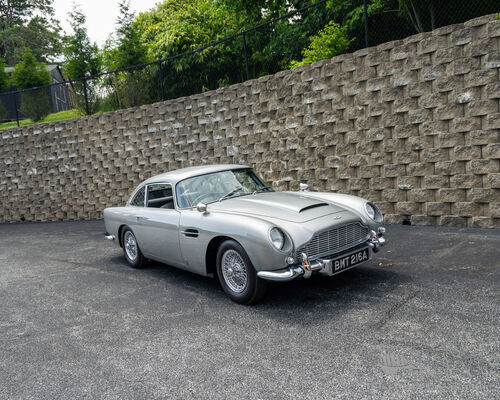
2020 Aston Martin DB5 Goldfinger Continuation
Proposée aux enchères par RM Sotheby's lors de The Monterey Auction, du 13 au 15 août 2026. Estimation : 1 000 000 à 1 500 000 USD
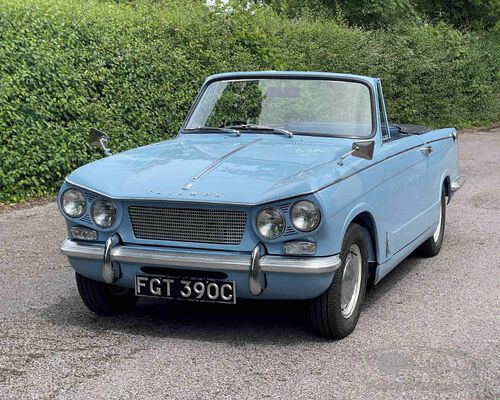
Triumph Vitesse 6 Convertible
Caractéristiques techniquesMarque et modèle : Triumph Vitesse 6 ConvertibleAnnée : 1965Immatriculation : Royaume-Uni