Le magazine et marché mondial pour les passionnés de voitures classiques, par des passionnés.





Les annonces; à vendre toutes voitures classique
Aperçu d’annonces associées à cette annonce 1976 Alfa Romeo Sports Coupé par Autotecnica del Lario
-

1968 Mercedes-Benz 600 SWB | Amelia Island Auctions | Gooding & Co | March 2-3, 2023
The magnificent Mercedes-Benz W100 Series 600 was one of the most prestigious and expensive luxury cars on the world stage in its day, and is among the most formal and opulent models ever offered by the lauded company. Brimming with creature comforts, and designed on a truly grand scale, the imposing 600 was Mercedes-Benz’s exclusive flagship fr.. -
1965 Ferrari 275 GTB | Amelia Island Auctions | Gooding & Co | March 2-3, 2023
Ferrari introduced the 275 GTB at the 1964 Paris salon as the replacement for its successful 250 SWB Berlinetta. To create a worthy successor, Scuderia Ferrari driver Michael Parkes had been brought in to assist with development and the latest race-bred innovations were incorporated. A rear-mounted, five-speed transaxle was fitted to improve bal.. -
1995 Alfa Romeo 155 D2 Superturismo | Amelia Island Auctions | Gooding & Co | March 2-3, 2023
The Italian Superturismo Championship was started in 1987 as Italy’s national motor sports series for touring cars. Originally run using FIA’s Group A specification, the series shifted to the new Superturismo category of cars in the early 1990s. Alfa Romeo brought its rich history in racing to the Superturismo series with a variant of its 155 se.. -
1949 Alfa Romeo 6C 2500 Super Sport Cabriolet | Amelia Island Auctions | Gooding & Co | March 2-3, 2023
The 6C 2500, introduced in 1938, was the final Alfa Romeo model powered by a Vittorio Jano-designed engine. Jano’s six- and eight-cylinder engines, some of the most revered in the automotive world, powered Alfa Romeo’s finest offerings before and after WWII. At the top of the 6C 2500 range was the Super Sport model, or SS, which benefited from a.. -
1966 Mercedes-Benz 250 SE Cabriolet | Amelia Island Auctions | Gooding & Co | March 2-3, 2023
The successful W111 line from Mercedes-Benz received numerous upgrades for the 1965 model year; of particular note was the increase in displacement to 2.5 liters. The remarkable example presented here is one of just 954 cabriolet variants completed for the worldwide market and is clearly among the best preserved of all extant. Sold new .. -
1966 Lancia Flavia Sport 1.8 Iniezione | Amelia Island Auctions | Gooding & Co | March 2-3, 2023
Renowned for innovative and effective engineering throughout its rich history, Italy’s Lancia introduced the Flavia in 1961, which served as the basis of one of the company’s most successful and versatile automobile lines. Recognized as Italy’s first front-wheel drive series-production automobile, the Flavia featured outstanding packaging and in.. -
1962 Mercedes-Benz 190 SL | Amelia Island Auctions | Gooding & Co | March 2-3, 2023
First shown at the 1954 New York International Auto Show alongside the 300 SL Gullwing, the 190 SL was the brainchild of US Mercedes-Benz importer Max Hoffman. Similar in appearance to the 300, yet less complex and costly, the 190 SL offered a sporting character without racing pretensions. Using proven mechanical components from the Ponton line,.. -
1973 Alfa Romeo Montreal | Amelia Island Auctions | Gooding & Co | March 2-3, 2023
Introduced at the 1970 Geneva Motor Show, the Alfa Romeo Montreal was a sleek 2+2 front-engine, rear-wheel drive coupe designed by Marcello Gandini of Bertone. Derived from the exotic Tipo 33 Stradale, the Montreal’s 2.6-liter, quad-cam V-8 with Spica mechanical fuel injection and dry-sump lubrication was mated to a five-speed ZF manual gearbox... -
1960 Autobianchi Bianchina Trasformabile | Amelia Island Auctions | Gooding & Co | March 2-3, 2023
Introduced to the world at the Paris Motor Show in spring 1957, the Bianchina was the first car to emerge from the newfound union between Italian industrial giants Bianchi, Fiat, and Pirelli. Featuring Fiat 500-based mechanicals, rear-hinged doors, unique trim, and luxurious appointments, the Bianchina was essentially a coachbuilt custom at an a.. -
1968 Alfa Romeo Giulia Sprint GTA 1300 Junior Stradale | Amelia Island Auctions | Gooding & Co | March 2-3, 2023
The 1960s saw a second golden age in the competition history of Alfa Romeo. Models such as the SZ, TZ, and TZ2, along with the Tipo 33 sports racing prototypes, made Alfa Romeo a potent force on the world’s circuits. The exciting production racing classes were not ignored either, with the 105-series Giulia Sprint GT providing the base for a high..



En promo
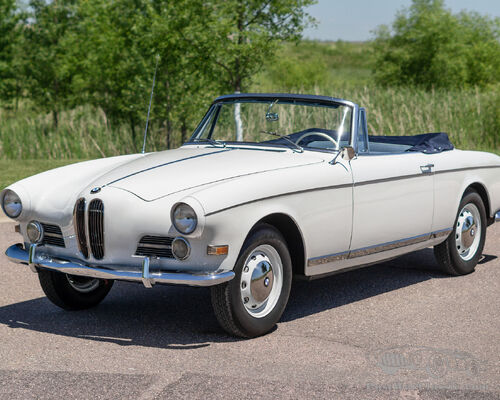
BMW 503 Cabriolet (V8) de 1957, 1 des 13 exemplaires construits pour le marché américain, exemplaire d'origine.
1957 BMW 503 Cabriolet Série 1 Moteur V8 en aluminium d'origine # correspondant Carrosserie en aluminium d'origine avec estampilles d'usine 1 des..
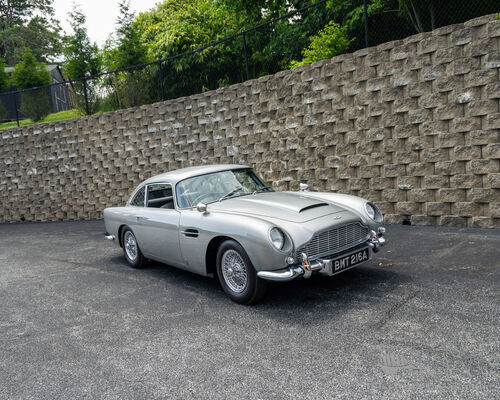
2020 Aston Martin DB5 Goldfinger Continuation | RM Sotheby's | The Monterey Auction
To Be OFFERED AT AUCTION at RM Sothebys' The Monterey Auction event, 13 - 15 August 2026. $1,000,000 - $1,500,000 USD One of 25 exampl..