Le magazine et marché mondial pour les passionnés de voitures classiques, par des passionnés.
Le magazine et marché mondial pour les passionnés de voitures classiques, par des passionnés.


Faites votre choix:
- Voir les voitures
-
Marque >>
-
Année >>
-
-
Catégorie >>
- Voir les motos
-
Année >>
-
- Voir les pièces et plus
-
Marque de la voiture >>
-
Constructeur >>
-
Catégorie >>
-
Pays



Les annonces; à vendre toutes voitures classique
Aperçu d’annonces associées à cette annonce 1972 MV Agusta 350 SPORT ELETTRONICA
-

Triumph Bonneville T120R 1970 for sale
• One of the most desirable Bonnevilles ever produced• Restored to factory spec condition650 cc air-cooled OHV vertical twin engine, 49 HP, four-speed constant mesh gearbox, front and rear drum brakesThe 1970 Triumph Bonneville T120 is considered by many British motorcycle historians as the high water mark in Triumph 650 development, and the year m..1970TriumphBonneville T120RVENDU -
Harley-Davidson XLCR Cafe Racer 1977 for sale
• A completely unrestored original XLCR• Just 1,650 miles from new998 cc two-valve 45 degree V-twin engine, 57 HP, four-speed manual gearbox, disc brakes, hydraulically dampened coil spring front suspension, independent Showa coil spring rearFirst released in 1977, the XLCR was a bold departure from the usual Harley-Davidson formula. You could call..1977Harley-DavidsonXLCRVENDU -
Norton mc Commando 850 MK3 828cc 2 cyl ohv 2611 1975 SOLD
When first produced in 1967, the Commando had a 750cc twin engine, from a design that had established its roots with the earlier 650cc Dominator and 750cc Atlas models. The Mk 3 Commandos were the first electric start-assisted Nortons to be offered, and 1975 was also the first year that footshift control was moved to the left side of the engine. Du..1975NortonCommando 850 MK3VENDU -
MV Agusta Ottantatre 83cc 2511 1959 SOLD
Introduced in 1958, the “Ottantatre” (Eighty-three) used an unusual engine displacement of 83cc. MV experimented with engine displacements and felt that 83cc was sufficient to power a motorcycle that could carry two people and still deliver acceptable fuel economy.While motorcycles today tend towards the bigger the better formula, in 1958, buyers w..1959MV AgustaOttantatreVENDU -
MV Agusta 150cc 2511 1953 SOLD
In 1950, the new MV Agusta 150 was produced in the Turismo and Sport versions.The 150 Sport was the entry-level bike, and was rated for 6 HP, giving the machine a top speed of 90 kph.Carburation was dellorto, while the electric system used Marelli components.Because of the lower power relative to upper-range 150’s the Sport’s brakes were smaller; b..1953MV AgustaVENDU -
MV Agusta CST 175cc OHC 2511 1954 SOLD
After WWII the Agusta family was no longer allowed to manufacture airplanes.It was decided to take up the production of motorcycles and in 1946 they brought out the “98”, a two stroke runabout.That same year a 98 Sport won the first race MV Agusta entered.This started the company on a competition path that would result in 37 world championship..1954MV AgustaCSTVENDU -
MV Agusta Ipotesi 350 2511 1977 SOLD
Although better known for their racing and road-going multi-cylinder machines, MV Agusta also built a range of stylish single- and twin-cylinder sports bikes throughout the 1950s, '60s and '70s. Introduced at the Milan Show in 1971, MV's first production 350 roadster was basically an over-bored version of the existing 250B model that had been aroun..1977MV AgustaIpotesiVENDU -
MV Agusta 150RS 2511 150cc 1 cyl ohv 1960 SOLD
This 1960 MV Agusta 150 RS is a sporty and swift machine and is equipped with an air-cooled, four-stroke, 150cc, single cylinder push-rod engine, paired to a four-speed manual transmission. The output is 13 HP.It has a drum braking system and a 13 liter fuel tank.The intake is by a Dell'Orto 22mm carburetor. Weight is approx. 110 kg.Max. speed is ..1960MV Agusta150RS 2511VENDU -
MV Agusta GTLS 125cc 1 cyl ohv 2511 1970 SOLD
Having commenced motorcycle production late in 1945 with a 98cc two-stroke, Meccanica Verghera (MV) introduced its first production four-strokes, a brace of 175cc singles, at the Milan Show in 1952, the newcomers’ advanced overhead-cam, unit-construction engine setting them apart from most of the opposition.The first 125cc production roadster - the..1970MV AgustaGTLSVENDU -
MV Agusta Tevere 235cc 1 cyl ohv 2511 1959 SOLD
When the Tevere 235 was unveiled in 1959, MV certainly had in mind, the more is better.Based on the popular 175 AB engine, the Tevere 235 used a larger displacement in an attempt to appeal to buyers wanting more power than the 175 could deliver.The Tevere 235’s 4-stroke OHV pushrod engine used the same stroke as the smaller powerplant, but the bore..1959MV AgustaTevereVENDU


En promo
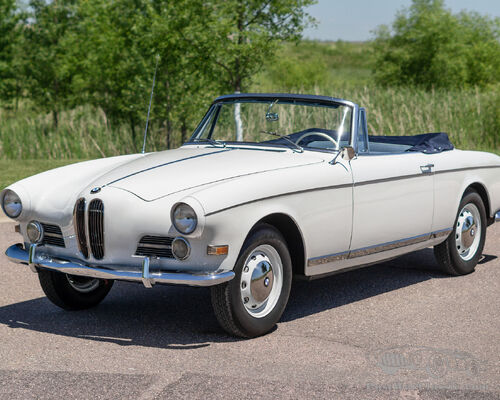
BMW 503 Cabriolet (V8) de 1957, 1 des 13 exemplaires construits pour le marché américain, exemplaire d'origine.
1957 BMW 503 Cabriolet Série 1 Moteur V8 en aluminium d'origine # correspondant Carrosserie en aluminium d'origine avec estampilles d'usine 1 des..