Le magazine et marché mondial pour les passionnés de voitures classiques, par des passionnés.





Les annonces; à vendre toutes voitures classique
Aperçu d’annonces associées à cette annonce 1972 Ferrari 365 GTC4 par Pininfarina
-

1964 Ferrari 500 Superfast | Amelia Island Auctions | Gooding & Co | March 2-3, 2023
The hands-down headline attraction among the 15 new designs exhibited by Pininfarina at the March 1964 Geneva Motor Show was the Ferrari 500 Superfast, which debuted as a larger, more powerful, and even more luxurious replacement for the 400 Superamerica. Based on its speed, power, and extreme cost, it captured the public’s imagination in a mann.. -
1977 Porsche 934/5 | Amelia Island Auctions | Gooding & Co | March 2-3, 2023
Launched in 1976, the 934 was built by Porsche to compete in the FIA’s Group 4 GT class, replacing the venerable Carrera RSR 3.0. While the new model was based on the production 930 Turbo, very little – aside from the road car’s body shell and engine case – remained unchanged in the transformation to race-ready 934. FIA regulations requ.. -
1967 Ferrari 275 GTB/4 | Amelia Island Auctions | Gooding & Co | March 2-3, 2023
In October 1964, the 275 GTB made its landmark debut at the Paris Motor Show alongside its open 275 GTS stablemate to replace the outgoing and long-running 250 GT and its many variants. The 275 GTB signaled an important evolution in Ferrari road cars, as it had a fully independent suspension layout, which had been tested, developed, and proven o.. -
1979 Pontiac Firebird Trans Am | Amelia Island Auctions | Gooding & Co | March 2-3, 2023
1979 saw a major transformation for Pontiac’s beloved Firebird, featuring a completely restyled body with improved aerodynamics, larger fender flares, and an enhanced rear spoiler. It also marked the end of the line for big-block V-8s from Pontiac with the optional 400 cid W72 V-8 engine. Claimed by Pontiac to produce 220 hp and 320 lbs./ft. of .. -
1973 Porsche 911 Carrera RS 2.7 Touring | Amelia Island Auctions | Gooding & Co | March 2-3, 2023
First developed to homologate the 911 for Group 4 racing, the Carrera RS 2.7 marked many firsts for Porsche. Launched in 1972, customers could choose from Touring and Lightweight models, both of which offered significant performance and weight savings over the standard 911S. Weight savings came by way of lighter-gauge sheet metal, thinner window.. -
1958 Ferrari 250 GT Tour de France Berlinetta | Amelia Island Auctions | Gooding & Co | March 2-3, 2023
In 1956, Ferrari responded to the FIA’s new GT Class championship by creating a dual-purpose, road-racing model based on the 250 GT. With a competitiontuned, three-liter V-12 and lightweight aluminum coachwork by Carrozzeria Scaglietti, the resulting 250 GT Berlinetta was a potent force in sports car racing through the late 1950s. The n.. -
1971 Mercedes-Benz 280 SE 3.5 Coupe | Amelia Island Auctions | Gooding & Co | March 2-3, 2023
Created in the Mercedes-Benz tradition of quality, engineering, and luxury, the W111 generation reached its pinnacle with the 280 SE 3.5. It introduced V-8 power to a Mercedes-Benz Coupe for the first time, adding heightened performance to the car’s virtues and furthering the heritage of the prestigious firm. This 3.5 Coupe was original.. -
1973 Ferrari 365 GTB/4 Daytona Spider | Amelia Island Auctions | Gooding & Co | March 2-3, 2023
Debuted in Paris in 1968, the 365 GTB/4 succeeded the 275 GTB/4 as Ferrari’s new top-of-the-line, two-seat gran turismo. Almost immediately, it was unofficially known as the “Daytona” in honor of Ferrari’s podium sweep at the 24 Hours of Daytona in 1967, and it stands as the last front-engine, V-12 GT model designed before Fiat’s takeov.. -
1994 Ferrari 512 TR | Amelia Island Auctions | Gooding & Co | March 2-3, 2023
Unveiled in 1984, the Testarossa was Ferrari’s flagship offering, which replaced the outgoing 512 BBi and introduced their iconic flat-12 to new markets. The famous wedge shape, coupled with its unique side strakes made its styling synonymous with the 1980s, popularized by the likes of Miami Vice and Out Run. The drivetrain was considerably impr.. -
1963 Ferrari 250 GT Lusso | Amelia Island Auctions | Gooding & Co | March 2-3, 2023
An Italian gran turismo of inimitable style, the 250 GT Lusso combined the finest qualities of Pininfarina design and Ferrari performance in one exceptional package. As the last-production 250 GT model, the Lusso was the culmination of a decade of steady chassis development and benefited from a rugged yet compliant suspension, ..



En promo
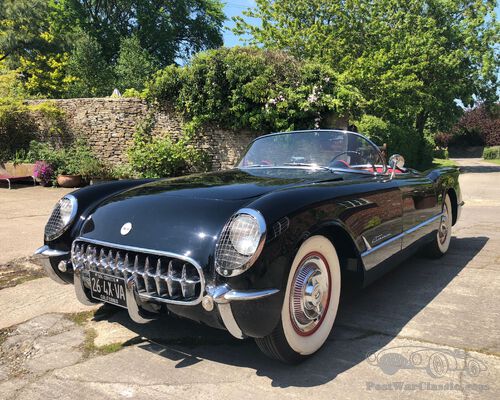
1954 Corvette C1
À la recherche de son prochain amour : mon élégante Corvette C1 de 1954. C’est une véritable sculpture. Jamais une voiture ne m’a valu autan..
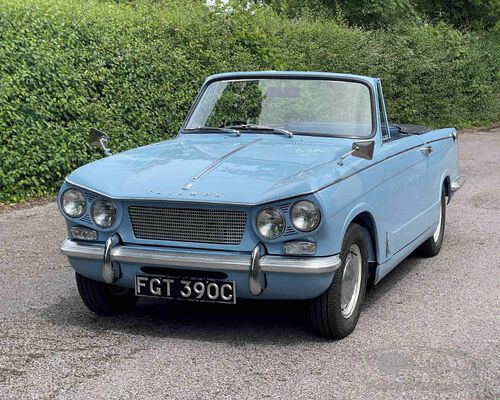
Triumph Vitesse 6 Convertible
Caractéristiques techniquesMarque et modèle : Triumph Vitesse 6 ConvertibleAnnée : 1965Immatriculation : Royaume-Uni
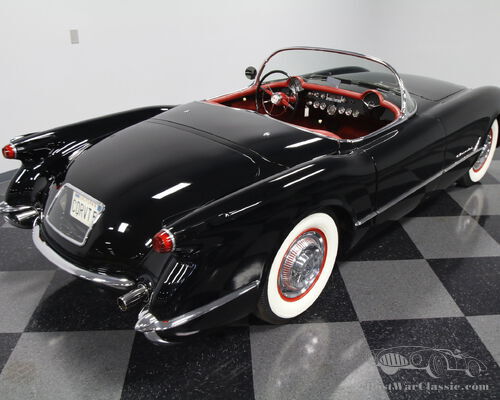
1954 Chevrolet Corvette C1
Fully restored 1954 C1 Corvette in Black. Stunningly beautiful car, feels like driving a sculptural work of Art. Known to be the oldest Corvette on t..